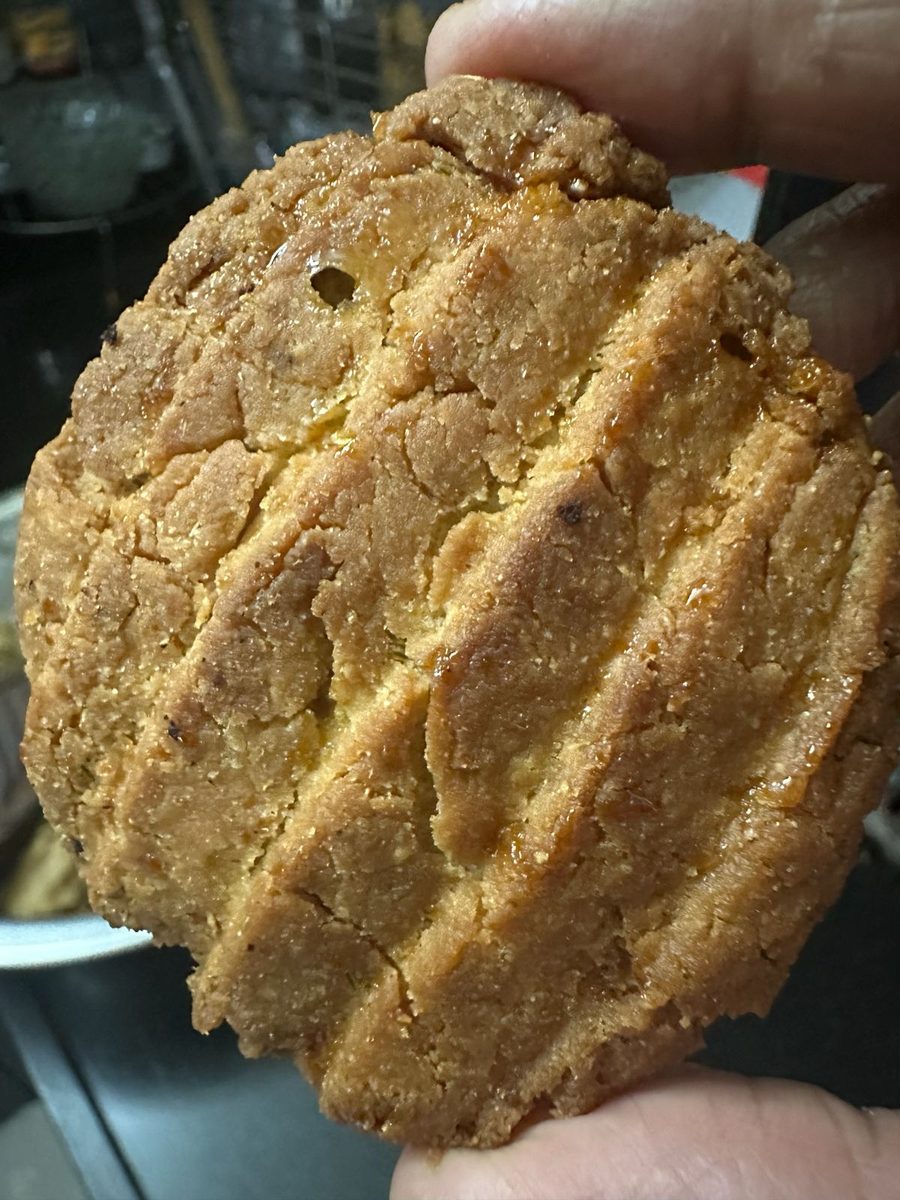
Ask anyone from Bihar what Thekua is and they will answer faster than you can finish the question. Ask someone from outside Bihar and they will look at you with polite uncertainty. This asymmetry is exactly the problem Rashmi is trying to fix — not by explaining Thekua, but by making it available in a city where most people have never tasted the real thing.
Not quite a biscuit. Not quite a cookie.
Thekua is made from whole wheat flour — atta, not maida — mixed with jaggery, ghee, and water into a stiff dough. It is hand-pressed and fried in ghee until deep golden and very firm. The texture: dense, crumbly without being dry, barely sweet, slightly grainy from the jaggery.
This is not a delicate sweet. Thekua is a food for standing outdoors in November, in the dark, waiting for the sun to rise over the river. It is made to last, to survive a festival, to travel in a tiffin from one village to another. Its density is its point.
"Koi nahi kehta ki thekua halka tha. Yahi toh baat hai — pet mein rehta hai."
( Nobody says Thekua was light. That's the whole point — it stays with you. )
Why Chhath is incomplete without it
Chhath Puja devotees fast for 36 hours without water, stand in rivers, and offer prayers at both sunset and sunrise. Thekua is one of the central prasad offerings — placed in a soop, offered to the sun. It is not bought from a shop. It is made by hand, the night before, with an awareness of what it means to make something sacred.
When Bihari families move to cities like Pune, this practice either travels with them or quietly fades. Rashmi's work is, in the simplest terms, keeping this from happening.